

Table of Contents
- Building a Minimalist Professional Wardrobe: The Core Pieces
- How to Style a Blazer for Work Without Looking Stiff
- The Perfect Trousers and Footwear for a Polished Look
- Why a Capsule Wardrobe Workwear Strategy Saves You Time
- Essential Accessories and Outerwear to Complete the Look
- How to Choose Fabrics That Last in a Minimalist Professional Wardrobe
- Frequently Asked Questions
Last Updated: September 24, 2026
Building a Minimalist Professional Wardrobe: The Core Pieces
A minimalist professional wardrobe is a small, carefully chosen set of clothing that covers every work occasion without decision fatigue. This approach works best when built around three anchors: a tailored blazer, a crisp shirt or refined knit, and well-cut trousers. Get those right and everything else falls into place.
The case for owning less is stronger than most people assume. According to research on clothing longevity and cost-per-wear, extending how long we wear our clothes is one of the most effective ways to reduce the environmental impact of what we buy. Fewer, better pieces worn more often simply make sense.
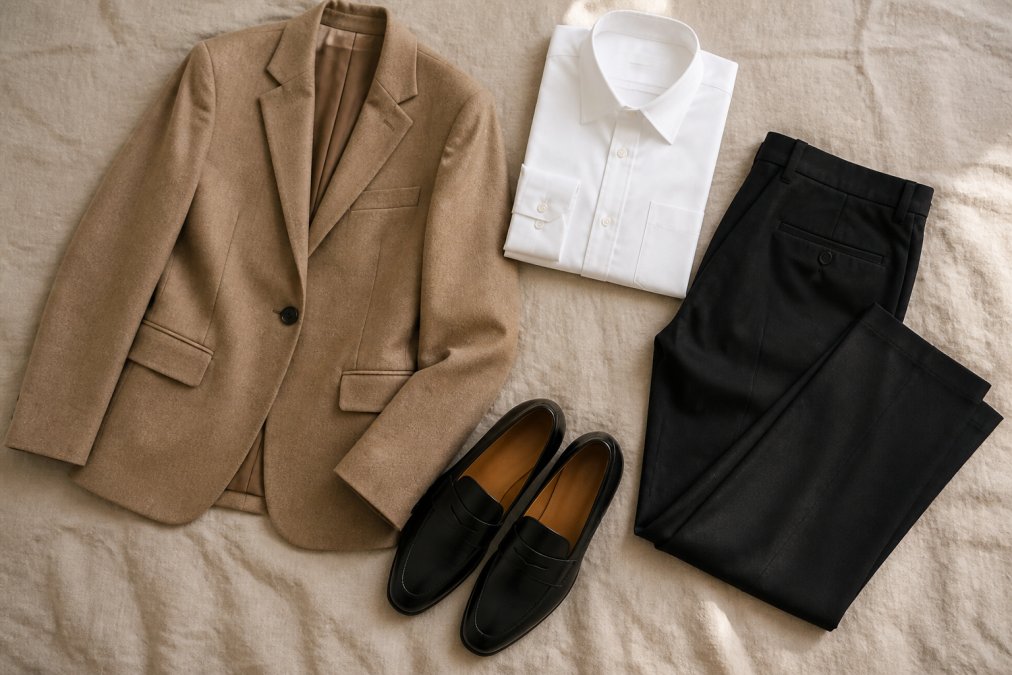
The Tailored Blazer: Your Wardrobe’s Anchor
A structured wool blazer does more work than any other piece you own. It sharpens a plain shirt, lifts a knit, and reads as considered even when you assembled the outfit in ninety seconds.
A wool hopsack style holds its shape through a long day and resists creasing better than softer weaves. Choose a single-breasted cut in navy, charcoal or camel, and treat it as the fixed point every other piece coordinates with. One good blazer worn three times a week beats five that each get an airing once a month.
The Crisp Shirt and Refined Knit
Your second layer is where versatility lives. A concealed-placket cotton shirt in white or pale blue covers formal meetings, while a fine merino roll neck handles the days in between.
Merino regulates temperature well, so it works under a blazer in a warm office and over a shirt on a cold commute. Two shirts and two knits, rotated, will outperform a drawer full of impulse buys.
How to Style a Blazer for Work Without Looking Stiff
The trick to styling a blazer for work is contrast: pair its structure with something softer. A formal jacket over a heavy cotton t-shirt, or tailored trousers with a knit rather than a stiff shirt, keeps the look contemporary instead of corporate-uniform.
Balancing Structure with Ease
Think about where the stiffness sits. If the blazer is sharp, relax the layer beneath. If the trousers are pressed and precise, choose a softer shoe or an unstructured bag.
A common mistake is matching formality across every element. That reads as dated. Deliberate contrast is what separates a modern professional look from a suit that belongs in 2011.
The Perfect Trousers and Footwear for a Polished Look
The ideal work trousers hold their shape from the 8am commute to an evening event. A high-rise, straight or wide-leg cut in a crease-resistant wool blend does exactly that, and a hook-and-bar closure keeps the waistline clean under a tucked shirt.
For footwear, minimalist leather loafers are the workhorse. Look for a cushioned insole and a rubber-injected sole if you are on your feet or walking between meetings. A short breaking-in period is normal and worth it; after that, a good pair lasts years.
- Trousers: neutral wool blend, straight leg, functional pockets
- Loafers: bovine leather, hardware-free, cushioned insole
- Colour logic: keep trousers and shoes in the same tonal family
Total time to assemble this base: roughly one afternoon of focused shopping, then years of not thinking about it.
Why a Capsule Wardrobe Workwear Strategy Saves You Time
A capsule wardrobe workwear strategy saves time by removing daily decisions. When every piece coordinates with every other piece, you stop standing in front of a full rail with nothing to wear. Ten to twelve items can generate weeks of outfits.
The maths is straightforward. Fewer pieces, each worn more often, means a lower cost per wear and less money tied up in clothes you rarely reach for. It also makes shopping faster, because you know exactly what gaps you are filling.
How Many Items Do You Actually Need?
Most professionals can build a complete rotation from around twelve core pieces. The table below shows how a minimal capsule breaks down.
| Category | Items | Purpose |
|---|---|---|
| Blazers | 1-2 | Structure for meetings and events |
| Shirts and knits | 3-4 | Layering and standalone wear |
| Trousers | 2-3 | Daily base, varied cuts |
| Footwear | 1-2 | Commuting and formal days |
| Outerwear | 1 | Weather protection |
| Bag | 1 | Carrying essentials |
Build the capsule around one accent colour, not five. Choose navy or charcoal as your base, then add a single accent you actually enjoy wearing. It keeps every combination working without a spreadsheet.
Essential Accessories and Outerwear to Complete the Look
Finishing pieces are what make a small wardrobe look intentional. A structured leather tote with a dedicated laptop compartment carries your working day without looking like gym kit, and a classic water-repellent trench handles unpredictable weather while staying sharp.
Accessories should be quiet. Minimalist hardware, neutral leathers and clean lines keep attention on the fit of your clothes rather than the labels. One well-chosen bag and one reliable coat will outlast a shelf of trends.
Buying accessories to “complete” an outfit before the core pieces fit properly is the most common mistake. A beautiful bag cannot rescue trousers that gap at the waist. Fix fit first.
How to Choose Fabrics That Last in a Minimalist Professional Wardrobe
Fabric choice decides whether a piece survives three years or three washes. Natural fibres such as wool, merino and cotton hold their shape and age well, while stretch blends add comfort for trousers you sit in all day.
Check two things before you buy: the fibre content on the label, and how the fabric recovers when you scrunch it in your hand. If it springs back, it will resist creasing at your desk. If it stays crumpled, it will look tired by lunchtime.
Care matters just as much. Wool blazers generally need professional dry cleaning, while cotton shirts and merino knits do best washed gently and dried flat. Treating each fabric according to its needs is what keeps a small wardrobe looking new.
Building a wardrobe that works every morning is harder than it looks, especially when you are choosing between dozens of near-identical pieces online. 78+ Designers curates premium men’s and women’s clothing and accessories for professionals who want quality without the guesswork, backed by a 30-day return policy, a 30-day money-back guarantee, and 24/7 support with live web chat. Shop now with 78+ Designers and build a wardrobe that earns its place.
Frequently Asked Questions
What are the core items for a minimalist professional wardrobe?
A functional minimalist professional wardrobe centres on a few key pieces: a structured blazer, two pairs of tailored trousers, three to four high-quality shirts or knitwear pieces, and a classic pair of leather shoes. Add a versatile trench coat and a structured tote bag. These essentials mix and match easily, giving you multiple outfits without needing a bulging wardrobe. Focus on neutral colours and quality fabrics that withstand regular wear and cleaning.
How do you build a capsule wardrobe for work?
Start by choosing a tight colour palette, such as navy, grey, black, and white. Select pieces that can be layered and swapped, like a blazer that works over both shirts and fine knits. Invest in fabrics that resist creasing and hold their shape, such as wool hopsack or stretch-wool blends. Aim for around 10 to 15 core items that can create at least two weeks of outfits. This approach simplifies your morning routine and ensures you always look polished.
How can I style a blazer for work without looking too formal?
To keep a blazer from feeling stiff, pair it with softer pieces. Try a fine-gauge merino roll neck instead of a button-down shirt, or layer it over a heavy-weight cotton t-shirt for a smart-casual Friday look. Choose an unstructured or single-breasted blazer in a textured fabric like wool hopsack. Leave the top button undone and avoid overly structured shoulders. This balances professionalism with approachability, making the blazer a versatile staple rather than a rigid uniform.
How many items do I need for a professional capsule wardrobe?
Most people find that 10 to 15 core items are enough for a professional capsule wardrobe. This typically includes two blazers, three pairs of trousers, four tops (shirts or knits), two pairs of shoes, and one or two outerwear pieces. The exact number depends on your work environment and how often you do laundry. A smaller, well-curated selection ensures you wear everything you own and reduces decision fatigue. Quality matters more than quantity here.
What are the best fabrics for minimalist workwear?
Wool, especially merino and wool hopsack, is excellent for blazers and trousers because it regulates temperature and resists creasing. For shirts, organic cotton poplin offers a crisp look and breathability. Fine-gauge merino wool is ideal for layering pieces like roll necks. Avoid overly synthetic fabrics that trap odour and pill quickly. Natural fibres with a bit of stretch, such as a wool-elastane blend, provide comfort and maintain a sharp silhouette throughout the day.


