

Table of Contents
- What Actually Drives the Price of Expensive Clothing
- The Cost Per Wear Formula That Settles the Argument
- How to Spot High Quality Clothing Before You Buy
- Timeless Fashion Pieces to Invest In
- Where Expensive Clothing Still Falls Short
- Frequently Asked Questions
Last Updated: September 14, 2026
What Actually Drives the Price of Expensive Clothing
Whether expensive clothing is worth the price comes down to what you are actually buying: materials, construction, and labour, not just the name on the label. A jacket that costs ten times more than a high street equivalent is rarely ten times better made, but it is often two or three times better made, and that gap compounds over years of wear. At 78+ Designers, we offer a curated selection of premium garments from a roster of labels.
The honest answer is that price and quality correlate, but they do not move in lockstep. Two garments can carry the same price tag for entirely different reasons.
Materials, Construction and the Cost of Craftsmanship
The single biggest driver of cost is fabric. Merino wool, cashmere, Irish linen and Japanese selvedge denim cost dramatically more per metre than polyester blends, and the gap widens further once you account for where and how the fibre was spun. Construction adds the next layer: canvassed tailoring, hand-finished buttonholes, French seams and pattern-matched prints all require skilled hands and slow production lines. Labour is the third cost, and it is the one most often hidden. A garment sewn in a factory with fair wages and reasonable hours will always cost more to produce than one assembled under pressure, and that cost lands on the price tag.
When You Are Paying for the Label, Not the Make
Some premium pricing is pure brand equity. A logo can add hundreds of pounds to a garment whose fabric and stitching are no better than a mid-market alternative. The tell is usually in the details: if the label is loud but the seams are loose, the buttons are plastic, and the lining is glued rather than stitched, you are paying for marketing. That does not make the purchase wrong, but it is worth being honest with yourself about what you are buying.
The Cost Per Wear Formula That Settles the Argument
Cost per wear is the total price of a garment divided by the number of times you realistically wear it. It is the simplest way to compare expensive clothing against fast fashion on equal terms, because it measures value over time rather than at the till. A £200 coat worn 100 times costs £2 per wear (Valuing our clothes: The cost of UK fashion | WRAP). A £40 coat worn five times before it pills or loses shape costs £8 per wear. The cheaper coat is four times more expensive in practice.
WRAP’s research on clothing longevity and textile waste has repeatedly shown that extending the active life of a garment is one of the most effective ways to reduce its environmental footprint. The financial case runs in parallel.
A Worked Example: Two Coats, Two Outcomes
Picture two wool coats. Coat A costs £400, is fully lined, has a canvas front and is dry-clean only. Coat B costs £80, is fused, and has a synthetic lining that pills after a season.
| Coat A (£400) | Coat B (£80) | |
|---|---|---|
| Wears per year | 60 | 40 |
| Years of service | 8 | 2 |
| Total wears | 480 | 80 |
| Cost per wear | £0.83 | £1.00 |
Coat A costs five times more at the till and still wins on cost per wear, before you factor in the fact that you will actually enjoy wearing it in year six.
The number that matters is not the price tag, it is the realistic wear count. If you cannot picture yourself wearing a piece at least 30 times a year, the cost per wear maths rarely works in its favour, however beautiful it is.
How to Spot High Quality Clothing Before You Buy
High quality clothing shows itself in specific, checkable details: fabric weight, seam finish, button attachment, and whether the garment holds its shape when you lift it by the shoulders. You do not need to be a tailor to spot the difference, but you do need to slow down for two minutes and look in the right places.
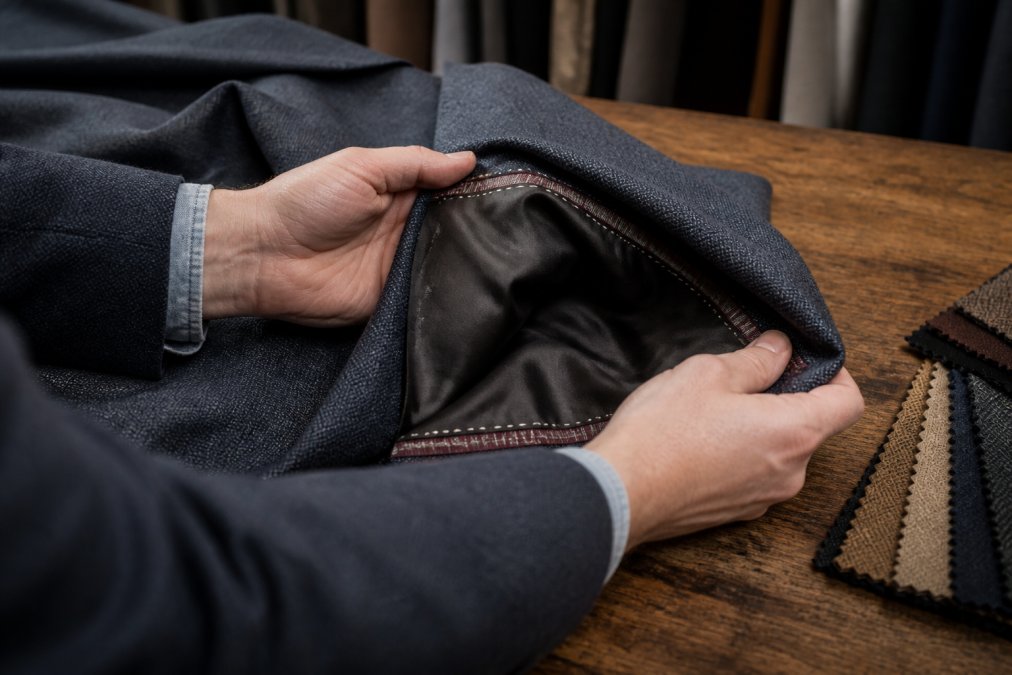
A practical checklist for inspecting any premium piece, online or in person:
- Turn it inside out. Look for clean, bound seams and no loose threads.
- Check the buttons. Are they sewn with a shank, or flat and about to fall off?
- Pinch the fabric. Does it spring back, or stay creased?
- Hold it to the light. Is the fabric dense, or can you see through it?
- Look at pattern matching at the seams. Do stripes and checks line up?
- Read the care label. Natural fibres with sensible care instructions are a good sign.
A common mistake is judging quality by feel alone in the shop. Softness can be engineered with chemical finishes that wash out after a few cycles. Check the construction, not just the hand-feel.
Timeless Fashion Pieces to Invest In
The pieces that justify a higher spend are the ones you will wear for a decade: a wool overcoat, a well-cut blazer, a pair of leather shoes that can be resoled, a cashmere or merino knit in a neutral colour, and a structured leather bag. These are the anchors of a wardrobe, and they are the categories where craftsmanship genuinely shows.
Trend-driven pieces, by contrast, rarely earn their price. If a garment is designed to look current for one season, buy it at a price that reflects that lifespan. This is the distinction most shopping guides miss: it is not expensive clothing per se that pays off, it is expensive clothing in the right categories.
The UK government’s guidance on textile labelling and fibre content is worth knowing if you buy online, because accurate fibre information is your first line of defence against misdescribed fabric.
Where Expensive Clothing Still Falls Short
Price is not a guarantee. Plenty of costly garments are poorly made, and plenty of mid-priced ones are excellent. The three most common failures at the premium end are glued rather than stitched construction, thin fabric dressed up with a designer name, and sizing that assumes a single body type. None of these are visible in a product photo, which is why return policies matter as much as the garment itself.
That is also why 78+ Designers offers a 30-day return policy and a 30-day money-back guarantee. If a piece does not live up to its price once it is in your hands, you should be able to send it back without a fight.
Expensive clothing is worth the price when the cost per wear is low, the construction is sound, and the piece fits your actual life. It is not worth the price when any one of those three is missing.
Frequently Asked Questions
Do expensive clothes actually last longer?
Often, but not automatically. Garments made from dense natural fibres with generous seam allowances and reinforced stress points can outlast cheaper equivalents by years, which is where the cost per wear formula works in their favour. However, price alone guarantees nothing. A high price tag can reflect marketing, exclusivity or a designer name rather than construction. Check the fabric composition, stitching and lining before assuming a higher price means a longer life.
What makes a piece of clothing worth a higher price tag?
Four things carry most of the weight: the fibre (cashmere, merino, linen and silk cost more than synthetics), the construction (full canvassing, French seams, matched patterns), the labour (hand-finished details take time), and the brand’s positioning. When all four align, expensive clothing earns its price. When only the label is premium, you are funding marketing rather than make. Ask which of the four you are actually paying for.
Does price always correlate with fabric quality?
No. Price and fabric quality correlate loosely at best. Some mid-priced brands use superb mills, while some luxury labels blend in polyester to cut costs. Turn the garment inside out and read the composition label: a wool coat with more than 20 per cent synthetic content will pill and lose shape faster than a pure wool alternative. Learn how to spot high quality clothing by feel and label, not by price alone.
Is it better to have a few high-quality items or a large wardrobe?
For most people building a working wardrobe, fewer but better wins. A small rotation of timeless fashion pieces to invest in, such as a wool coat, a well-cut blazer and quality leather shoes, covers more outfits than a wardrobe of trend-led pieces that date within a season. The cost per wear formula usually favours the smaller, sturdier wardrobe, provided each piece genuinely suits your lifestyle and gets worn regularly.
Deciding whether a premium piece earns its place in your wardrobe takes time, and most shoppers are doing it alone with nothing but a product photo and a price tag. At 78+ Designers, we curate high-end designer clothing and accessories for people who want substance over noise, backed by a 30-day return policy, a 30-day money-back guarantee, and 24/7 support with live web chat so you can ask before you commit. Shop the collection and build a wardrobe that pays you back wear after wear.


