

Table of Contents
- What You’ll Need to Inspect a Garment
- How to Check Clothing Construction: Seams, Stitching and Finish
- Best Natural Fabrics for Longevity: Wool, Cotton, Silk and Linen
- How to Read Clothing Labels for Quality: Fibre Content and Care
- Spotting High Quality Garments: Red Flags and Deal-Breakers
- Does Price Always Reflect Quality?
- Frequently Asked Questions
Last Updated: 10 September 2026
What You’ll Need to Inspect a Garment
You do not need a laboratory to judge how to spot high quality garments. A few simple tools and ten minutes of daylight will tell you more than any label ever will. This guide walks through the exact checks to apply when assessing premium clothing for curation.
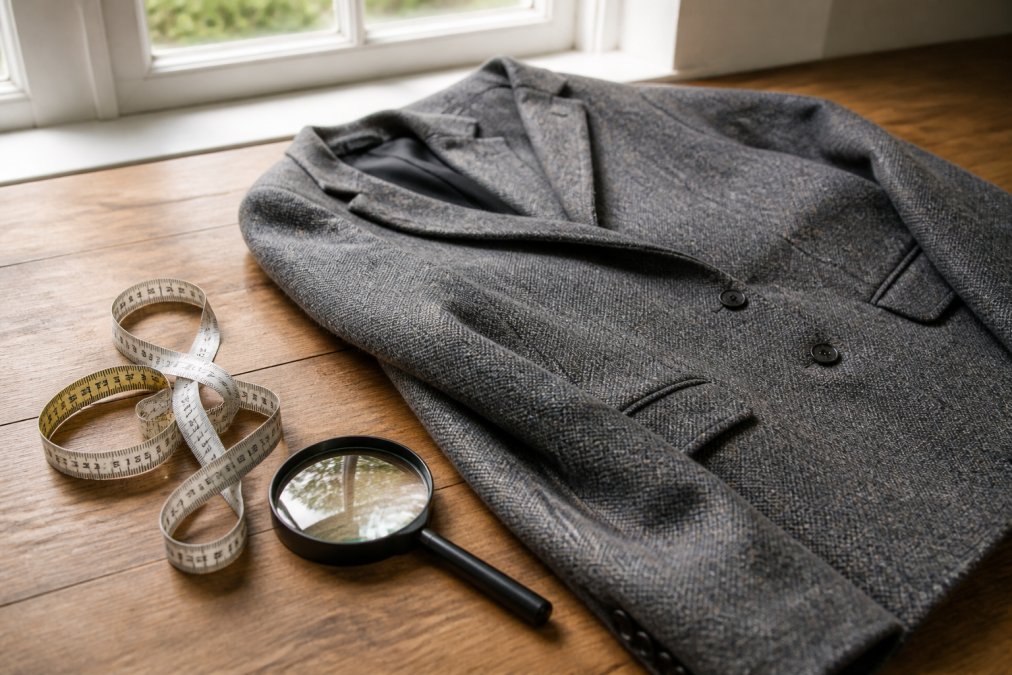
Here is the full kit:
- A tape measure (centimetres, not inches, so you can compare against stated measurements)
- A magnifying glass or your phone camera zoomed in for stitch counting
- A lint roller or sticky tape to test surface fibres
- Good natural light near a window, since artificial bulbs hide weave irregularities
- A small notebook to record measurements of pieces you already own and love
That last item matters more than people expect. Once you know the shoulder width and sleeve length of a jacket that fits you perfectly, every online purchase becomes a comparison exercise rather than a gamble.
How to Check Clothing Construction: Seams, Stitching and Finish
Construction is where quality hides or exposes itself. Turn the garment inside out before you look at anything else.
A well-made piece has clean interior finishing: no loose threads, no raw edges fraying into the lining, no puckering along the seams. If the inside looks like a workshop floor, the outside will not hold up for long.
Seam Types and Stitch Density
The strongest seams are bound or French seams, where the raw edge is fully enclosed. Next best is a flat-felled seam, common on denim and workwear. A simple overlocked edge is acceptable on casual pieces but a warning sign on tailoring.
Stitch density tells you how much care went into assembly. Count the stitches in 1 centimetre:
- 8-10 stitches per cm: solid, durable construction
- 5-7 stitches per cm: acceptable for lightweight fabrics
- Fewer than 5: the seam will likely pull apart under stress
Hardware, Linings and Interfacings
Buttons should feel substantial and sit on a shank, not flush against the fabric. Metal zips from established makers glide without catching. Plastic zips on a jacket described as premium are a deal-breaker.
Check the lining separately. A quality lining is attached with a generous seam allowance so the garment can move without tearing. Interfacing, the hidden layer that gives structure to collars and cuffs, should feel bonded rather than loose. If you can peel the collar apart with your fingers, it will bubble after one dry clean.
Best Natural Fabrics for Longevity: Wool, Cotton, Silk and Linen
Natural fibres age better than synthetics because they can be repaired, re-woven, and refreshed. The best natural fabrics for longevity share one trait: they improve with care rather than degrade.
Wool holds shape, resists odour, and regulates temperature. Look for tightly twisted yarn with a slight sheen, which signals longer fibres. Cotton should feel dense and smooth, not thin and papery. Silk has a subtle irregularity in its weave; perfectly uniform silk is usually synthetic. Linen creases sharply and feels cool, and cheaper blends with polyester will feel clammy instead.
Fabric Weight and Weave Density
Hold the fabric up to the light. If you can see individual threads spread far apart, the weave is loose and will wear through quickly.
Weight is measured in grams per square metre (GSM). A cotton shirt around 120-140 GSM feels substantial; anything under 100 GSM will be transparent and short-lived. Wool suiting typically sits between 250 and 350 GSM. Heavier is not always better, but density almost always is.
How to Read Clothing Labels for Quality: Fibre Content and Care
Labels are legally required to state fibre composition, and that single line tells you more than the brand name above it. The Textile Products (Labelling and Fibre Composition) Regulations 2012 set out what UK labels must legally declare, including fibre content and any non-textile animal parts.
Read the percentages in order. Fibres are listed by weight, so “95% cotton, 5% elastane” is a different garment from “60% cotton, 40% polyester.” A small percentage of elastane adds stretch and recovery. A large percentage of polyester in a product marketed as luxury is a cost decision, not a quality one.
Certifications and Origin Markers
Look for recognised certification marks rather than vague claims. Independent certifications worth knowing include OEKO-TEX for chemical safety, GOTS for organic cotton, and Woolmark for pure new wool. A “made in” statement tells you where the garment was assembled, not where the fabric was woven, and those are often different countries.
WRAP UK textile recycling guidance notes that fibre composition also determines whether a garment can be recycled, which is worth considering if you plan to keep a piece for a decade.
Spotting High Quality Garments: Red Flags and Deal-Breakers
Some faults cannot be fixed by a tailor. Walk away when you see these:
| Red Flag |
|---|
| — |
| Loose or bubbling interfacing |
| Single-stitched stress seams |
| Plastic zips on tailoring |
| Vague fibre labels |
| Asymmetric pattern matching |
The most common mistake is judging a garment by its hanger appeal. A piece can look sharp on the rail and still have a single-stitched seat seam that fails within weeks. Always turn it inside out before you commit.
Does Price Always Reflect Quality?
No. Price reflects brand positioning, marketing spend, and retail margin as much as it reflects construction.
A high price tag guarantees neither good stitching nor honest fibre content. What it often buys is design, exclusivity, and aftercare. That is not worthless, but it is not the same as durability.
The practical approach is to separate the two questions. Ask first whether the construction passes your inspection. Then ask whether the design and service justify the premium. At 78+ Designers, we curate premium men’s and women’s pieces with a 30-day return policy and a money-back guarantee, so you can inspect a garment properly at home.
Photograph the label and interior seam of any piece you keep. If it fails within a year, you have a clear record of what the construction looked like when new, which is useful evidence for a returns claim.
Frequently Asked Questions
What are the signs of high-quality fabric?
High-quality fabric feels dense and substantial, with a tight weave that resists light penetration. Natural fibres like wool, cotton, silk and linen often show slight irregularities that indicate authenticity. Check for a dry, crisp hand-feel rather than a slick or overly soft finish. Fabric weight matters too: heavier garments tend to drape better and last longer. If the fabric pills easily or feels thin, it is likely a lower grade. Always inspect the fabric under natural light to see its true colour and texture.
How can you tell if a garment is well-constructed?
Turn the garment inside out and examine the seams. Quality construction uses clean, finished seams with no loose threads or raw edges. Stitching should be tight, even and consistent, with about 8 to 12 stitches per centimetre. Check that patterns match at the seams, especially on stripes or checks. Buttons and zips should feel secure and operate smoothly. Linings should be attached neatly and not baggy. A well-constructed garment lies flat when laid out and does not twist or pucker along the seams.
Does a higher price tag always mean better quality?
No, price is not a reliable indicator of quality. Some expensive brands rely on marketing and name recognition rather than superior materials or construction. Conversely, lesser-known labels can offer excellent craftsmanship at moderate prices. Focus on tangible details: fabric content, stitch density, seam finishes and hardware quality. A high price may reflect design, exclusivity or brand prestige, but it does not guarantee longevity. Always inspect the garment itself rather than assuming cost equals quality.
How do natural fibres compare to synthetic materials for longevity?
Natural fibres like wool, cotton, silk and linen generally age better than synthetics. Wool resists odours and holds its shape, cotton softens with washing without losing strength, silk retains lustre and linen becomes more supple over time. Synthetics such as polyester and nylon can pill, snag and retain odours, though they offer durability and stretch. Blends can combine benefits, but a high natural fibre content (above 70%) usually signals better breathability and comfort. For investment pieces, natural fibres are often the better long-term choice.
Judging quality takes practice, and the stakes are highest when you are buying online without the chance to turn a garment inside out first. 78+ Designers curates premium pieces with the construction checks above already applied, backed by a 30-day return policy, a 30-day money-back guarantee, and 24/7 support with live web chat if you need sizing guidance before you order. Build a wardrobe where every piece earns its place. Shop now with 78+ Designers.


